Last One, Let’s Make it Count!

What goes through one’s mind as they are experiencing a change in perspective? Are there certain steps that one must take in order to think differently? One of my best friends challenged me with new thought and ideas that I am going to be sharing with you in this blog, today.
 

img_1097
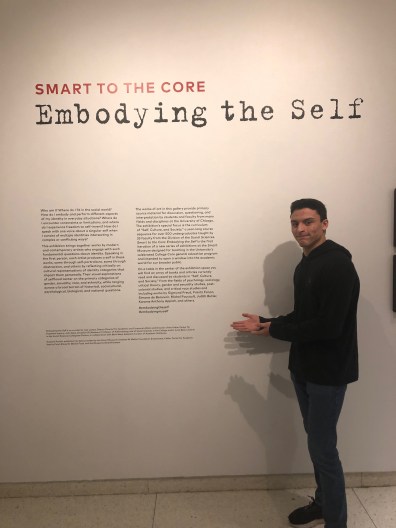
Kyle Williams: “Embodying the Self” Exhibit

I went to the Smart Museum of Art at the University of Chicago with the Williams family on May 4th, 2019. It was a sunny day and a pretty cold one in fact, but I was excited to go see this exhibit and really try and write a good SAMO to end off senior year. Mr. Williams drove all of us down from Northbrook to the University in about 35-40 minutes. It was free parking as well as free admission into the exhibit, so if you do not want to spend any money whatsoever, then this is the perfect place to do your SAMO!

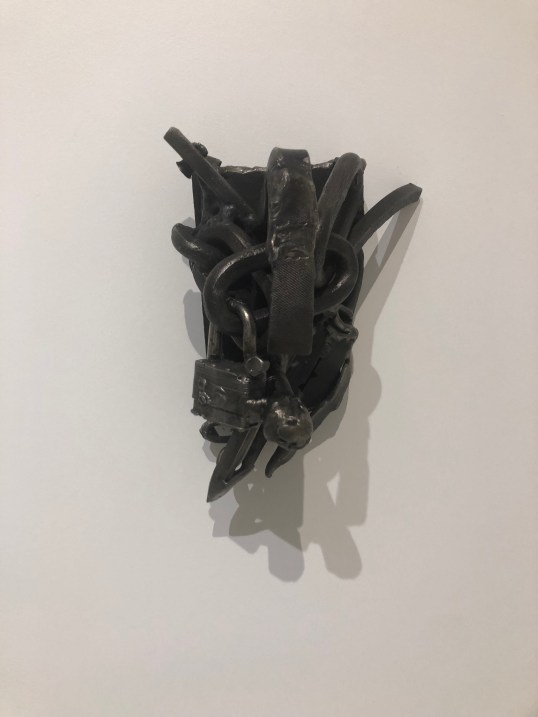
Immediately as we entered the exhibit, the first thing that caught my eye was the “Lynch Fragments”, by Melvin Edwards. For some reason, I had this feeling that I saw this piece somewhere before. Then, it hit me, because I saw this at the Museum of Contemporary Art with a friend of mine earlier this semester for a potential SAMO.
img_1060
Melvin Edwards: “Lynch Fragments”

During the time when Edwards made this piece of art, the 1960s, African Americans were facing discrimination and segregation laws that made it difficult for equality to take place in the American society. It was his response to the violence, that he made the fragments in order to show what exactly White Americans did to Blacks to strike fear into their hearts and show their “superiority” over the “inferior” race. It’s amazing how pieces of metal can have so much meaning, and draw out so many emotions and memories from times of pain and suffering that we all can feel and sadly imagine the experiences people went through at that time.

img_1071
Kevin Beasley: “Vine”

There was something that I definitely felt and learned as I went through the exhibit: Visual art has a powerful and chilling effect, where it can draw out emotions that makes you seek understanding and different perspectives that you never may have thought before. Kevin Beasley, an American artist in the mid-1980s, used very simple, maybe to some people, unappealing objects, and turned them into something beautiful, giving the audience a different way to look at these things and make the viewers think differently in a positive way. Beasley created “Vine” in 2016, a piece that was made with old grungy t-shirts and baseball hats. When I looked from afar, I didn’t notice that these objects were used in the artwork, but as I got closer, I was very interested in it because I found it so fascinating that he used something that I would never have used in art, and transformed it into a masterpiece.

Now, this next one is something that I, personally, am not so proud of. Jennie C. Jones created “SHHH #6” in 2012, and it consisted of a noise-canceling instrument cable, wire, and felt. As Elise and I looked at this piece of art, we thought that it represented a noose that was used to hang African Americans back in the day when it was popular to hang them for pleasure in White communities. Kyle kept telling us that it could also represent a treble clef, a type of symbol that indicates the range of notes on the scale. For some reason, Elise and I didn’t want to take that into consideration and we couldn’t see where he was possibly coming from, but when he told us to come to where he was standing on the side in a slanted view, it became clear that he saw something that we didn’t.

img_1147
Jennie C. Jones: “SHHH #6”

I was very surprised to see that it looked very similar to the treble clef in music, and was very ashamed that I was so stuck in my own mind that I didn’t realize that there could be multiple ways of looking at one piece of work, and everyone thinks a little bit differently. I didn’t even think about what it would be like if someone literally states, “Dude, you’re wrong”. In today’s society, we are so stuck in our own ways of thinking, and we aren’t willing to be disturbed and change our own perspective. After this, I began to think that it’s imperative that we all make an effort to understand each other and not just brush each other off when we don’t see eye to eye.

Ever since the exhibit, I’ve been reminiscing about the old SAMOs that I have done for this class, and it amazes me how each and every one of them has taught me this very important lesson: There always is something to learn and to take in from the work of others. Each time, I have gone with friends or family members that challenged my close-minded thinking and made me see the multiple beauties of artwork from many different time periods and types of people. SAMOs are amazing experiences that I would definitely recommend to prospective CST English students, and I wouldn’t want that to change.

Thank you, Mrs. Galson, for making this year a very difficult, yet interesting experience for all of us. You molded me into a better version of myself and challenged me to think outside of my comfort zone and use my imagination and deeper thinking in order to make these blogs.

Signing off,

Christopher

A Simple Example Can Lead To Powerful Thinking

I want you guys to think for a moment about this simple example that could possibly lead to an unending discussion of human rights and what we consider to be our own property: You are in a doctor’s office getting a regular physical, checking up with your physician once every year to make sure that you are physically healthy and there is nothing wrong with you. Remember when you were a kid, and you just hated getting your blood taken every single time because it was a scary process? Well, even as I am now a fully legal young adult, after reading “The Immortal Life of Henrietta Lacks” by Rebecca Skloot, I am even more terrified of what goes on in the doctor’s office.

Did you know that your blood, when it leaves your body, could possibly not be considered as your own anymore?

Even though that blood was in you for a long time and had been circulating throughout your body for as long as you could remember, it’s all fair game for the taking when the doctors do yearly examinations. Potentially, they can do whatever they want with it and not have to ask for your consent in terms of secondary research. Even if you were to voluntarily give up bodily objects and fluids, they could still be used for profits and commercialization, which you would have no say in where the money that could be made from it would go. “‘You can’t ignore this issue of who gets the money and what the money is used for… I’m not sure what to do about it, but I’m pretty sure it’s weird to say everybody gets money except the people providing the raw material’” (323). Henrietta Lacks’s family specifically, never even saw a penny out of the millions of dollars that were made from HeLa cells. How would you feel if companies were making multi-million dollar profits off of your cells, and you didn’t get anything out of the deal? I’m thinking that you would feel pretty shittily if you ask me. Back in the 1960s, African Americans and Whites were segregated, and African Americans were under a lot of pressure due to racism, and could not fight for their rights at all, which made Henrietta’s situation a lot more difficult.

Besides Henrietta Lacks, there have been other examples of commercial use of one’s cellular composition with voluntary consent, but a lack of compensation due to the loophole that implies that those body parts are no longer owned by the donor. A man in the 1970s, John Moore, sued UCLA (University of California Los Angeles) because a doctor at the university “developed a cell line from Moore’s T-lymphocytes and patented this cell line… Between 1984 and 1990, the patent earned more than 3 billion dollars” (“Ethical and legal considerations regarding the ownership and commercial use of human biological materials and their derivatives”). Due to legal binding of ownership due to the patent, John Moore was left with nothing, and the court ruled his statements of ownership to be false, due to the fact that although the cells that were given to the university were Moore’s, the ones that were patented in terms of the cell line were descendants of the original cells, which denied his right to sue against the commercial use of these “new/fresh” cells. It’s mind-boggling to me that we, as humans, could manipulate the law and find loopholes in order to gain personal achievement and profit from someone else’s loss and pain. If you read my first blog in this series, then you definitely know that acts like these are blatant deceit, and go against the laws of ethics. 

However, there has been some good that came out of this situation. For example, due to Henrietta and her family’s event with Johns Hopkins Hospital, new laws have been placed to further protect the rights of patients as well as to discourage doctors and scientists that practice unauthorized research and experiments. One of the laws was the Common Rule. “Since the mishandling of Henrietta’s rights, the government has acted comprehensively to protect research subjects… the creation of the so-called Common Rule… is shorthand for the Federal Policy for the Protection of Human Subjects that was first published in 1991 to protect vulnerable categories of test subjects” (Stump 130). Although the Common Rule was established approximately 30 years after Henrietta’s case, it still shows a progressive movement forward that is leaning towards the protection of those that could possibly be mistreated or lied to about where exactly parts of their body are contributing to as well as whether or not it is ethical to do such research if it invades patient privacy.

I think that it is really important for us as a community, as well as individuals, to stand up for ourselves and expose what really is going on in the medical research system. Granted, these facilities have helped create scientific breakthroughs and developed vaccines in order to prevent diseases from spreading. But, I do not think that it is fair to cut the donor out of the deal and to have to lie and twist a law in order to get what you want. The next time you go to the doctor’s office, just think about what exactly “good” people can do with what is rightfully yours, and what you can do in this world to protect it.

Signing off,

Christopher

Are You Ready To Win?

Calling to ALL GBN STUDENTS, do you guys remember freshman year Biology? Probably not, cause if you’re an upperclassman, why would you? It’s at this point where our concept of time is just so out of wack that we can’t even remember what we had for breakfast last Monday (could be just me though). But if you’re a freshman that’s doing my game in the ERC, then welcome!

I’m here to talk to you guys of a cell. Well, a couple of cells, actually. No, wait; as of 2010, there are more than 50 million metric tons of HeLa cells in the world today, and the number will just keep on getting higher,

And higher,

And higher…

HeLa cells are cancerous cells from the 1960s that are the only ones in the world that can continuously divide if sufficient time and energy were spent on them.

The real question is, why exactly should we, as students of GBN, care about these cells and read about them as though they are extremely important to us? Although these cells have caused an immeasurable amount of breakthroughs in science, I wanted to take an ethical approach to the entire history behind it.

It’s pretty interesting how we as students are taught specifically of the scientific purposes of the HeLa cell, but not the person who brought us this gift in the first place. The book that tells of Henrietta Lacks’s story, “The Immortal Life of Henrietta Lacks” by Rebecca Skloot, is a very powerful book that unveils the dark side of companies and the health systems back from the early 1930s all the way up to present day. Paul and Elder, the writers of “The Thinker’s Guide to Ethical Reasoning”, would definitely have not been pleased, whatsoever.

I want all of you to think about an event that occurred in the 1930s for a moment. Now, you tell me if the outcome seems ethical in any way:

“U.S Public Health Service researchers at Tuskegee Institute decided to study how syphilis killed, from infection to death. They recruited hundreds of African-American men with syphilis, then watched them die slow, painful, and preventable deaths, even after they realized penicillin could cure them” (50).

There are two acts that are “unethical in-and-of-themselves”, as Paul and Elder would have called them, in this situation. Racism (treating people unfairly due to their ethnicity or race) and Deceit (Fooling someone for personal gain or a certain outcome) are a nasty combination if used in this kind of way. During the 1930s, African Americans definitely did not have access to a good education, they were poor, and they for sure did not have any knowledge of diseases besides how it can kill you. They would do anything in order to live and get rid of it. The Tuskegee Institute, at that time, was only made up of White Americans that did not care for African American suffrage. In fact, they considered black people expendable, just like the white mindset during the hundreds of years of slavery they had to go through. “The research subjects didn’t ask questions… the researchers offered incentives: free physical exams, hot meals, and rides into town on clinic days, plus fifty-dollar burial stipends for their families when the men died… black people were ‘a notoriously syphilis-soaked race’” (50). Now, I know what you’re thinking: “This can definitely not happen anymore in today’s society.” Well, I’m here to tell you that you’re wrong. Henrietta Lacks’s family, as of present day, still suffers from the monetization of her cells, and the multi-million dollar corporations that were created, due to the cell’s rare properties, still do not give any of the profits back to the ones that have it in their DNA… If your cells contributed to saving millions of lives, and other people were to have profited from them, how would you feel? At that time, the family couldn’t even fight back, because they were uneducated and didn’t know the importance of those cells. Henrietta’s husband, Day, didn’t even know what “cells” were until Rebecca Skloot explained to him what they actually were. African Americans were mistreated because of their lack of education and the event of the HeLa cells proves it. What makes this situation even more frustrating is that Johns Hopkins Hospital, the one that treated Henrietta for her cancer, wanted to see why exactly HeLa cells were the only cells that are considered “immortal” in the world. So, they tricked the family into thinking that the doctors needed to test their blood for possible signs of cancer within the family, but it was just to explore Henrietta’s family in order to find out more information about her cells. I don’t know about you, but I’d say their behavior was way over the line in terms of invasion of privacy, as well as blatant deceit coming from doctors that were supposed to help their patients, not just for personal gain.

If you finished reading this blog to the end, I applaud you! You’ve completed the game and are on the edge of receiving a prize! Please come talk to Michael Shen or me, and tell us one thing you learned from this blog, as well as this code word: HeLa. All of our information is written on the board in the ERC and feel free to reach us to claim a LARGE KING SIZED CANDY BAR!

Thank you for playing!

From, Christopher

Ed Ducated’s Visual Analysis

Background: A father and son that live on Jim Crow Road in Flowery Branch, Georgia, go head to head in a conversation that is both eye-opening and disturbing.

Characters:

Une Ducated:

  • White
  • Age 54
  • Lived on Jim Crow Road for his whole life
  • Against changing the name of the road

Ed Ducated:

  • White
  • Age 18
  • Fighting to change the name of the road


Ed: So dad, I understand that the street that we live on was not the same Jim Crow as we all know and despise in America, right?

Une: Yes, son. We’ve been over this many times. Jim Crow was named after Glenn Crow. He was called ‘Jim’ or ‘Jimmy’ as a kid and he stuck with that name ever since. Why do you ask this again and again?

Ed: Well, we’ve been reading this book called Citizen: An American Lyric, by an African American writer named Claudia Rankine. It’s pretty good if you ask me.

Une: Well, what’s got you into looking at the history of our street then? I don’t see how it can relate.

Ed: The first picture that’s shown in the book is a picture of our street. It was interesting to me that our lesson plan last class was all about how you can get a lot of information out of one picture by using the method called Visual Analysis.

Une: You talkin’ bout that “a picture means more than 1000 words” load of crap?

Ed: Yes, dad. Don’t have to call it crap. It’s actually spot on. The first step is to collect observations and write them all down. They don’t have to have any sort of analysis or deep thinking. You just don’t leave any detail unnoticed.

Image result for jim crow road
Michael David Murphy: “Jim Crow Rd.”

Une: Well if there’s no analysis whatsoever, then what the hell are you supposed to do with that?

Ed (Annoyed): I’m gettin’ to that part, dad. Just hear me out. Now that you’ve done all of the groundwork, you can start going to the next level of thinkin’ and NOW you can interpret the observations how you like. For example, see how all these houses in the pictures are white? You barely see any of the color black anywhere. Maybe a little bit on the windows and such, but overall the entire picture mainly focuses on the white colored houses.

Une: Uh, aren’t you just bein’ too big of a wuss? I mean, I just like the color white, so that’s why our house was painted that color. Also, black’s just a nasty color for a house. It makes it dirty and I don’t think people like that.

Ed: Not necessarily dad. We read this essay about somethin’ called the “Pain Scale” by Eula Biss. Her piece really emphasized that people have different definitions of the word “Pain”. She gives many examples about different topics such as physical, mental, and emotional pain and gives us readers her perspective on it and challenges us to rethink. She said “My father is a physician. He treats patients with cancer, who often suffer extreme pain. My father raised me to believe that most pain is minor. He was never impressed by my bleeding cuts or even my weeping sores. In retrospect, neither am I” (68).

Une: So you’re saying that pain is relative and that we shouldn’t ignore other people’s pain even though it might seem teeny tiny small in comparison to what others go through every day?

Ed: Exactly! Think about it pops: We have this thing called empathy. It’s a complex emotion that is used in everyday life when we want to experience and understand how others are feelin’. For example, if I were to get a scrape on my leg from fallin’ off my bike, you would remember the time you fell off your bike as a kid and the pain that you would go through. Sure, maybe you didn’t feel the same amount of pain and it might’ve not hurt at all cause you’re big and strong. But for me, it hurt a hell of a lot more. But you still took care of me and made me feel a lot better and you told me everythin’ was gonna be okay.

Une: But how does that relate to our road? I’m still confused ‘bout that.

Ed: We learned ‘bout microaggressions in school last week. They basically are unconscious remarks that we make about others that don’t seem offensive to us, but in reality, they are. They just keep bitin’ us like mosquitos in the summertime. One might not seem like a big deal, but when a whole pack of ‘em come at you and you get a lot, it hurts. When we say that keeping the Jim Crow Rd. is alright and doesn’t offend anyone, you don’t know that. If my friend James, who is African American, were to live on this street, I don’t think he would necessarily go berserk, but he would probably feel uncomfortable every time he walked past the sign because of African American history. You feel me, dad?

Une (Scratches head): I guess so. Never really put it into that perspective before.

Ed: Get this: The last step is the trickiest. Now that we’ve put our own thought into the picture, it’s time to try and get the author’s perspective and see how it relates or differs to your own. Like I’m thinking that the artist wanted the sign to stand out, so that’s why he placed it in the middle of the photo. We wouldn’t really notice it as much if it were to stand out on the side and it would make it seem as “unimportant”. The photographer, Michael David Murphy, is a white male that’s lived in Atlanta for quite a while now. I think that he took this photo to give African Americans power because they know that they have an agent group on their side. In my opinion, if a black man were to have taken the picture and published it, it wouldn’t circulate around the community as much as it would have with Murphy taking the picture. You know?

Une: You’re right. It seems as though a real change could occur if whites were to help African Americans with their fight for equality and justice in today’s society. Why do you think that the author of this book you’re readin’ put our picture right at the start of the book?

Ed: Well, a page or two after the picture, Rankine talks about an “unsettled feeling keeps the body front and center. The wrong words enter your day like a bad egg in your mouth and puke runs down your blouse” (8). Sure, it’s definitely an exaggeration, but when African Americans first see this street and it says “Jim Crow” on it, they don’t think of Glenn, but they think of the laws of segregation that hurt their people. As I was reading this, it made me feel like she wanted to get as much out of me as possible and using quotes like these, in the start of the book, makes it really powerful and can draw out empathy from anyone that’s willing to listen. It was really effective to use this picture at the beginning of the book because it prepared me to go about reading with an open heart and mind to new and disturbing ideas, dad.

Une: Wow, son. You sure seem to know your stuff. Continue doing well in school and I’ll try to see what I can do with the name of the road when I see their family today over lunch.

Ed: Gee, thanks pops!

“Stateless”

Have you ever wondered what it was like to be homeless? In today’s society, even the homeless have benefits such as unemployment, food stamps, or a certain amount of money they are given every month to live life minimally. But if you did have one, what would you do if the government told you that you had to go leave the only place that you called home? Would you cry, kick and scream until you were beaten and torn apart from it by force? As of 2018, the United Nations Refugee Agency estimates that there are about 66 million refugees around the world today, combating the constant struggle of lacking a place to live. “Stateless, Views of Global Migration” is an exhibit within the Museum of Contemporary Photography in Chicago, Illinois, that focuses in on people’s real stories as refugees and what it was like for them to live their lives to the best that they could.

IMG-0726
“Stateless, Views of Global Migration” Museum of Contemporary Photography, January 26th, 2019.


As I woke up on January 26th of 2019, I couldn’t wait to travel on the train to the Chicago Union Station with my best friend Sebastian. The train ticket itself costs 10 dollars, but the exhibit is free, which gave a lot of incentive to go on this trip. Every time that we would travel to the city, I would always ask him what it was like to live there in Lincoln Park, a somewhat dangerous neighborhood that was filled with drugs and violence. He would always say, “Dude, let’s just say that you don’t want to live there. It’s filled with a lot of hate whenever I think of it, man.” He would tell me about his mom and how hard it was for her to come to the United States as a Mexican adult woman in her 20s. She would always be talked to by whites as though she was a foreigner that knew nothing about the country. Even to this day, it seems as though after 20 years, that stigma still hasn’t changed as we see a lot of discrimination and microaggressions against those south of the border. In my English class, we talked about how sometimes, there are little things that we say to others that can potentially hurt their feelings in the long run. Microaggressions occur in our everyday lives and we aren’t even aware of it.

Mosquito bites affect some more than others. But in the end, it still hurts if you have gotten bitten multiple times in many different places. Sebastian and his mom have to go through their daily lives with a weight on their shoulders that they are “different” than everyone else. In order for us to become more aware individuals, we need to find ways to reduce the number of microaggressions that go around and we should be more conscious of what we say and how we act towards others.

When we got to the Museum, I was pretty surprised when I walked in and saw a tiny 20*40 ft exhibit. The room looked very minimalistic, forcing one’s eyes to capture the importance of the photos as well as the descriptions that came along with them.

What really stood out to me within the exhibit was this painting.

This slideshow requires JavaScript.


When you first look at this piece, what do you think of? To some, all you see is a piece of mail with a plant on it. Nothing special, right? If this is you, you certainly have not taken our CST class! We learned to critically analyze works of art and how there’s always a list of observations that may seem to have no meaning, but are hidden symbols of what truly the artist is trying to express. If you look closely, you will see an address. Texas: the state that borders Mexico. When I think of Texas, I think of the border, don’t you? I think of illegal immigrants that try and cross the border every single day to hopefully reach a place that they can thrive and express their hopes and dreams that they wouldn’t be able to accomplish back at home. You see an accounting company label on the top left corner of the envelope. What is inside the document? Probably paperwork that can identify who a person is as well as how long they have been living in the United States for? It can be a person’s proof of citizenship that allows them to keep staying in the states. This painting was created by Fidencio Fifield-Perez, an artist that has continuously applied and reapplied to DACA, the Deferred Action for Childhood Arrivals. In order to prove that they exist in the United States, these people have to always have some sort of identification such as “bills, school report cards, social media posts, letters, and receipts”.

Are.

You.

Kidding.

Me?

Think about how humiliating it must be to have to carry onto old methods of identification, just to prove that you exist in a country that is supposed to be filled with joy and a new start to life? It is frustrating to see that in order to have evidence that you live in the US, some people have to use SOCIAL MEDIA POSTS! After the exhibit, I felt that I needed to apologize to Sebastian, for all the crap he must have gone through living in Chicago 10 years ago. He would always shrug it off and tell me that it was nothing; but deep down inside, I knew that this exhibit struck something in his heart that was personal: A true connection that rocked his bones.

Leaving the exhibit, I felt so many feelings at once that made me extremely confused. Simultaneously, I was feeling energized, angry, and emotionally struck by what I experienced there. When we got back to the train, we talked nonstop about how much that exhibit shook us, and how other people shrug off the pain and suffering of people today that have to deal with the discrimination and racism every day, like a painful tick that just won’t go away. Why does the cycle of socialization continue? Why must we intentionally hurt others’ feelings in order to feel a sense of superiority in today’s world? These are questions that came out of my mind when I got home after a long day of a hard experience to take. I would definitely recommend this to any CST learner out there in the world, looking to explore and try to feel what it’s like to always be looked at like an outsider.

Feel free to comment your thoughts and feelings about these questions and maybe we can get a discussion going! I would love to hear what everyone has to say about the matter and what we can do to spark change in the world we live in.

Signing off,

Chris

Inside the Mind of a Typical Gang Member

Can we truly feel empathy? Can we truly understand other people’s experiences and what they go through based off of situations that are similar to theirs? This was a topic of question that my English CST class discussed last Thursday. In “My Bloody Life: The Making of a Latin King”, by Reymundo Sanchez, the author goes through the lives of gang members in the Latin Kings of Chicago, and the struggles and violence that they partake in daily. Even if people in the Northshore can’t relate to living in the hood and see the pain and suffering of the people of Chicago, how can we understand them on a personal level? We, as humans, never react exactly the same as one another, even in precisely the same circumstances. Abraham Maslow, a renowned psychologist in the 1940s, published a pyramid that is known as the “Hierarchy of Needs”, in order to explain what goes through the minds of everyday people. Each level on the pyramid gives us a better understanding of the human mind and the priorities that allow us to see why humans do what they do.


sdfaghrah
Maslow’s Hierarchy of Needs For a Typical Gang Member


In Maslow’s Hierarchy of Needs, the Physiological aspect is always first. The base of an entire pyramid that cannot function without these basic needs, is usually the one that falls first in the life of a gang member. They would place drugs and sex over food and water and would waste all of their money just so that they could have that euphoric feeling for just one minute longer… “I didn’t bathe or change clothes for weeks at a time. I spent most of my time drinking and getting high. I rarely ate full meals anymore. They were a luxury. Getting high made me forget about being hungry. I slept in the gutter most of the time: rooftops, benches, hallways, gangways. Call them what you want, they’re still the gutter” (247).  Because of Reymundo’s drug addiction, he would change his priorities of food and water with cocaine and marijuana, which gives us a better understanding of why he acts a certain way and how his choices are affecting his life by being a gang member.


Question:


What would you do if your mother was an abusive bitch that fell under the authority of the selfish stepfather that only cared about his own children and hated your guts? We’d probably just cry and complain here in the Northshore. But in the hood, children have to grow up quickly. They don’t have time to sit around, sulk and wait for someone to come rescue them. “Stories of abuse while the other parent ignores the cries for help are all too common where I was raised. Mostly it was uneducated, unskilled, and scared mothers who ignored the abuse. The memories of my mother’s ignorance were so vivid as I listened to China. That’s what China and I and many other gangbangers had in common. These memories bonded us together. That’s why gang members embrace each other’s acts of violence. That’s why they go to jail for one another. That’s why gang members kill and die together. That bond relieves the pain of what is the truth” (99). Due to their abusive and violent environment, most children are forced to join gangs in order to protect themselves and feel safe. The idea of having multiple people to protect you at a moment’s notice is a very reassuring feeling, and I think that you too have people that will come running when you need help or are feeling a lot of pain and suffering in any situation.

latin
Brotherhood of the Latin Kings

I left Fulfillment blank…

Why?

The book ends with a series of events that all lead to the point when Reymundo decides to quit out of the gang. The ending scene is just him getting beat up by two fellow Latin King brothers, and him walking out of the warehouse as a free man. Did he truly learn his lesson? Has he found what his purpose in life is yet? We can’t know for certain how his life is gonna turn out. Because we are human, we cannot read each other’s minds. That’s why Maslow created a Hierarchy of Needs in the first place, to give us the power of EMPATHY: to see where people’s minds are at and how consciousness affects every one of us. 

Signing off,

Christopher

If you want to read more about consciousness and how it affects our lives and those around us, click here!


Not Everything is Black or White

What makes a SAMO important to me isn’t just the fact that I get to choose my own experience, but that I don’t have to learn solely on my own perspective and base my ideas of what I gather myself. People who challenge and force you to be willing to be disturbed are the best kind to take along. On December 26th, 2018, my friends and I went to the Chicago Cultural Center to visit the African American Designers in Chicago’s exhibit, “Art, Commerce and the Politics of Race”.

We started off the day with me driving to pick up the boys from their respective houses. I was excited because I had never driven into downtown before. But, I was scared because I’ve heard awful things about the driving habits of Chicagoans. To be honest, it wasn’t that bad. I think that people made assumptions and bias about this because most people, themselves, have not needed to drive into the city until later on in life, like me. We as Northshore “rich” kids choose to live in a bubble where we are afraid of uncomfortability. We took a 10-minute walk from our parking spot to the facility, and we got to see how busy the streets of Chicago really were.  

img-0658
African American Designers in Chicago: “Art, Commerce and the Politics of Race” Trent, Casey, Kyle, Joey, Chris

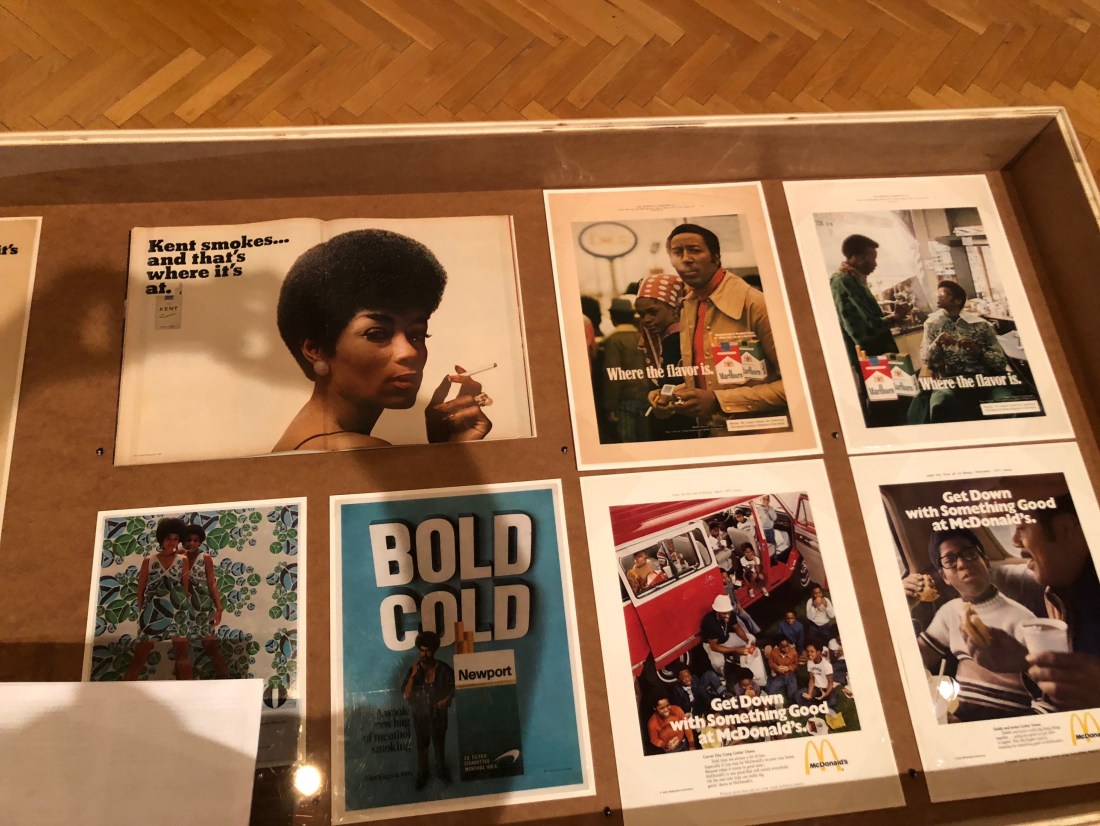
Something that I found interesting was a case of different perspectives of a certain set of pictures within the gallery. Trent, another fellow CST classmate, perceived these pictures to be a negative way of expressing African American characteristics and habits in the 20th century. He saw of it as the media portraying them as horrifying smokers who eat an extreme amount of junk food such as Mcdonalds. Although that does seem like a decent argument, I thought of it as more of a way of creating a sense of unity between people in the United States. Family culture is a large aspect in any community, regardless of where you live. In most places, there are certain characteristics that are clearly seen to all as the “norm”, and the magazines and the media just portrayed the African Americans doing it as a way of saying, “Hey, we are just like whites, don’t separate us based off of color.” Would some people say that it is wrong for African Americans to be in these types of magazines that are setting a bad example for future generations as well as portraying all African Americans a certain way? Yes, that’s a possibility, but I do see where the media is coming from. Everything isn’t just plain black and white. There’s always going to be multiple possibilities that explain a topic or a subject in life. If we sit and argue about which one is correct, how are we going to be able to grow and expand our thinking? Our willingness to be disturbed would not be challenged, but it would be afraid to step foot into the real world. 

img-0650
African American Magazines of Macdonald’s and Newport Cigarettes

As a minority, I also sometimes see myself trying to express characteristics that might seem off to some people because it doesn’t fit my “profile” of being Asian. I like to be extremely into fitness and do certain things like walk around Woodfield Mall, and play football with my teammates. We like to eat American food such as cheeseburgers, onion rings, and fries occasionally on a weekday, and we function how a normal American family would.

Whenever I go to Chicago, I feel as though it is due to an obligation that restricts me from truly see what exactly is going on there. As we walked from the parking lot to the facility, I noticed homeless people begging for money with signs. But they would never communicate with us. As they lay on the cold floor, I began to feel that each one of them had a sense of learned helplessness, a Psychology term that is used to describe an organism losing sight of a purpose due to the thinking that all trails lead to the same outcome of failure.

I’m glad to have gone to Chicago with an open mind that SAMOS aren’t supposed to be obligations, but a time to reflect and make use of the time spent to take a look at it from multiple lenses.

Go check out my friends’ links to their blogs!

Trent

Kyle

Casey

Joey


Conscience is a Child

Most people can argue that everyone has a little voice inside of them debating what is right from wrong. That little voice: whispering and placing judgements onto certain actions and potential outcomes as though it is an omniscient being of its own.

The definition of conscience in the Webster dictionary is “the sense or consciousness of the moral goodness or blameworthiness of one’s own conduct, intentions, or character together with a feeling of obligation to do right or be good”. But what if I told you that some people don’t have the voice in their head? Or that they do have a conscience, but it can’t always distinguish what is right from wrong?

I believe that your conscience is like a child that needs to be developed, nourished, and put on the right path.

Let me give you a scenario to understand my thinking better.

You are controlling a set of train tracks that has two options. On the first track, there are 5 tied up human beings, against their will. On the second track, lays solely one human tied up as well. The train is coming with no possibility of stopping. Which situation is morally correct? There are some that say to save five is better than saving just one. But who are you to decide who is to be killed and who gets to live? Some choose not to make a choice at all due to shock, and are sometimes ridiculed for not making any decision at all.

If you chose the saving one person option, you are Doctor Stockmann, a scientist from Norway that chooses to debate the importance of economic stability and ethics. In the book “Enemy of the People”, author Arthur Miller creates an adaptation of the play by Henrik Ibsen, where two brothers go head to head on the topic of saving an entire village of poverty, versus saving individuals from a disease-causing hot spring to gain an enormous amount of wealth. “You expect me to remain in charge while people are being poisoned?” (71). Although Dr. Stockmann doesn’t see the fact that he is endangering the lives of many citizens in his community, he chooses to save one because he believes that his decision is morally and ethically correct.

However, if you chose to save the five people instead of one, you are Peter Stockmann, a politician with a great deal of power in his community at his fingertips. Peter chooses to benefit the entire community and have a small amount of people pay the price by having the Kirsten Springs bring in money from other communities and ignoring the probability that people get sick from the warm “bacterial” water. “As soon as the rumor gets around that the water is dangerous, we won’t have a visitor left… Kirsten Springs are the blood supply of this town, Thomas, the only future we’ve got here. Now will you stop and think?” (29) By turning the blind eye to the potential hazards of the springs, Peter chooses to think about the overall economic stability of the community over safety.

For my CST class, we were given a hefty amount of memoirs to choose from, and pick one to read for the month of December. I chose the book “My Bloody Life” by Reymundo Sanchez, where the main character comes from a rough past of being brutally beaten on a consistent basis, was raped, became a stoner, joined the Latin Kings (the largest Latino gang in Chicago), and lacked a conscience from the very start. Conscience for him wasn’t at all developed due to his experiences and the lack of “good” influences that didn’t push him to fully understand himself and the world around him. “I was only thirteen. I was too young to understand that what Maria did was wrong. At the time I thought sex with an older woman was the stuff of dreams. Now I know that’s bullshit. Yes, I learned about sexual feelings that night, but nothing else. No emotions or thoughts were shared. It was sex and nothing more” (47). Because Reymundo did not perceive anything to be wrong, his conscience was telling him that having sex with an adult as a child is conventional and not taboo to society at all. Reading this book, I had learned that conscience is something that needs to be built, not assumed that it is always going to be morally or ethically correct. 

A baby learns how to walk by watching their parents and family members that push the child to grow up and mature. Conscience learns what is right and wrong by taking multiple perspectives and uses the knowledge obtained from past experiences in order to make an executive decision of what is right and wrong in your life.

So before you make a judgement onto someone or something that might seem like an obvious choice to oppose the action, think BEFORE you act. Ask the right people that have spent years of gaining multiple perspectives of others’ actions and how they would go about the situation as well.

Signing off,

Chris


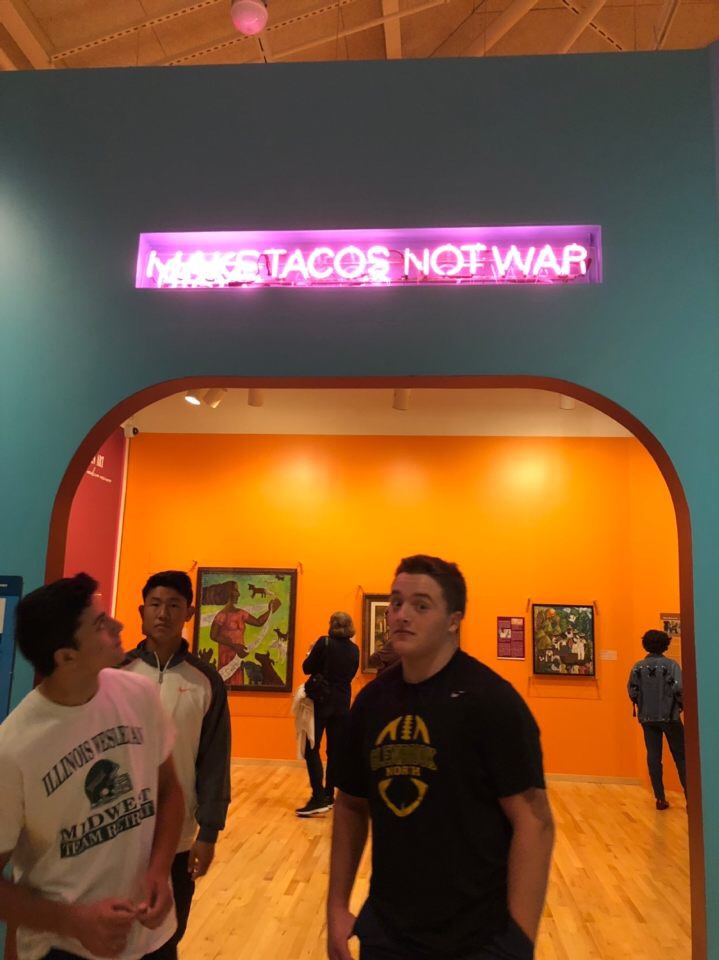
Make Tacos Not War


IMG_0493
“Make Tacos Not War”


Make Tacos Not War

Make Tacos Not War”. Funny, isn’t it? This quote calls out for a more serious meaning that we as the audience have to find and interpret for ourselves. When I think of tacos, I think of the one Mexican food that is known around the whole world. Everyone enjoys them, and have nice conversations over them. It’s a sign of unity between nations, and those who believe themselves to be enemies of others come together and just sit down and devour tacos in one bite.

This September, I had the opportunity to experience the Museum of Mexican Art with some of my closest friends at Glenbrook North High School. What made this trip so fulfilling wasn’t just the time I spent at the facility, but the experience as a whole where I got to meet a Mexican Uber driver immigrant that talked about Mexican History, explored an area where I was disturbed and in the dark, and I had a chance to hang out and chill in a big city like Chicago.

IMG_0484
“National Museum of Mexican Art”


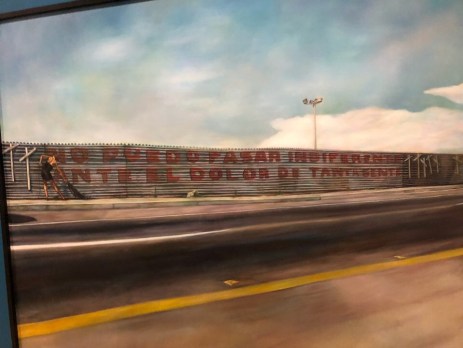
When I was looking around the exhibit, I saw this picture that read, “No puedo pasar indiferente ante el dolor de tanta gente”. This means “I can’t pass indifferent to the pain of so many people”. On the left side of the picture, there is a woman with a vacuum cleaner just cleaning up the dust that accumulates by the train car. In my perspective, the woman and the vacuum cleaner show that so many people block out other people’s problems by doing something else. When one vacuums, it is really loud and completely blocks out all other noises.


IMG_0491

As we got off of the train at Union Station, we decided to Uber to the museum. It just so happened that we met a driver named Sergio, and he was a Mexican immigrant that wanted a better life here in the United States. We talked in the car about his story and how he came to the United States about 15 years ago. He came here with his mother and studied English at a university. He praised our country and told us the horrors in Mexico, and how everyone struggles to survive there because of its bad living conditions, lack of sanitation, and lack of money to have a better life. It made me think about Mrs. Galson, my English teacher that went on a trip to help out people in an African country during her time in the Peace Corp. She had to live in an environment that wasn’t comfortable at first, and had similar living conditions, but she told our class that she had an enjoyable experience and she would love to do it again. During our talk with Sergio,what really shook me on the inside 

was that he was satisfied with being an Uber drive. Someone on the north shore would be like, “Dude that’s a low life job. We gotta go to college and make a lot of money to provide for our families. Thisis man was happy to be alive and he now has a better life than what he did before. I believe that we as humans undermine the successes of those that are less fortunate than us and we make them feel as though they aren’t as great as us in the middle and the upper class.


As we were driving to the National Museum of Mexican Art, we came across some apartments that had some meaningful paintings scattered across each brick wall. These paintings gave me a sense of who the people in the area were, as well as how they showed their identity to the world. I remember vividly when we whizzed past by the complex, and I exclaimed out of nowhere, “GET THE CAMERA, GET THE CAMERA!” I was amazed how the paintings almost seemed alive, and they were calling out to me. They were telling me to remember them.


IMG_0355 (1)
Painting in Chicago Near the Museum


Overall, this experience was an eye-opener, where I learned that there is a whole other world of people, perspectives, and places that I haven’t taken the time to really dive into yet. I’m glad that I have started this journey of understanding something more than just myself and my environment one step at a time.

Blog Addresses 

trenchanttribune.home.blog

shen.home.blog

http://keypressingwkyle.code.blog

Where Do I Stand?

Where Do I Stand?

I feel like I am not from this world

Every individual has categories of which they live in:

A Coalition

An Organization

A Community

A Nation

But where do I stand?

Where do I belong?

Invisible Systems at work

Keeping me from my true identity

“Don’t worry about it”

“Not my problem”

Human nature makes us think like that

It’s Universal…

It’s funny

Right?

We all connect to one another

All living things

But in something that is not ethical

To create a new world

Something bigger than me

Or You

Or anyone in the universe

A force that reasons and gives us a place to be joined together

Wouldn’t that be…

Nice?

group hand fist bump
Photo by rawpixel.com on Pexels.com